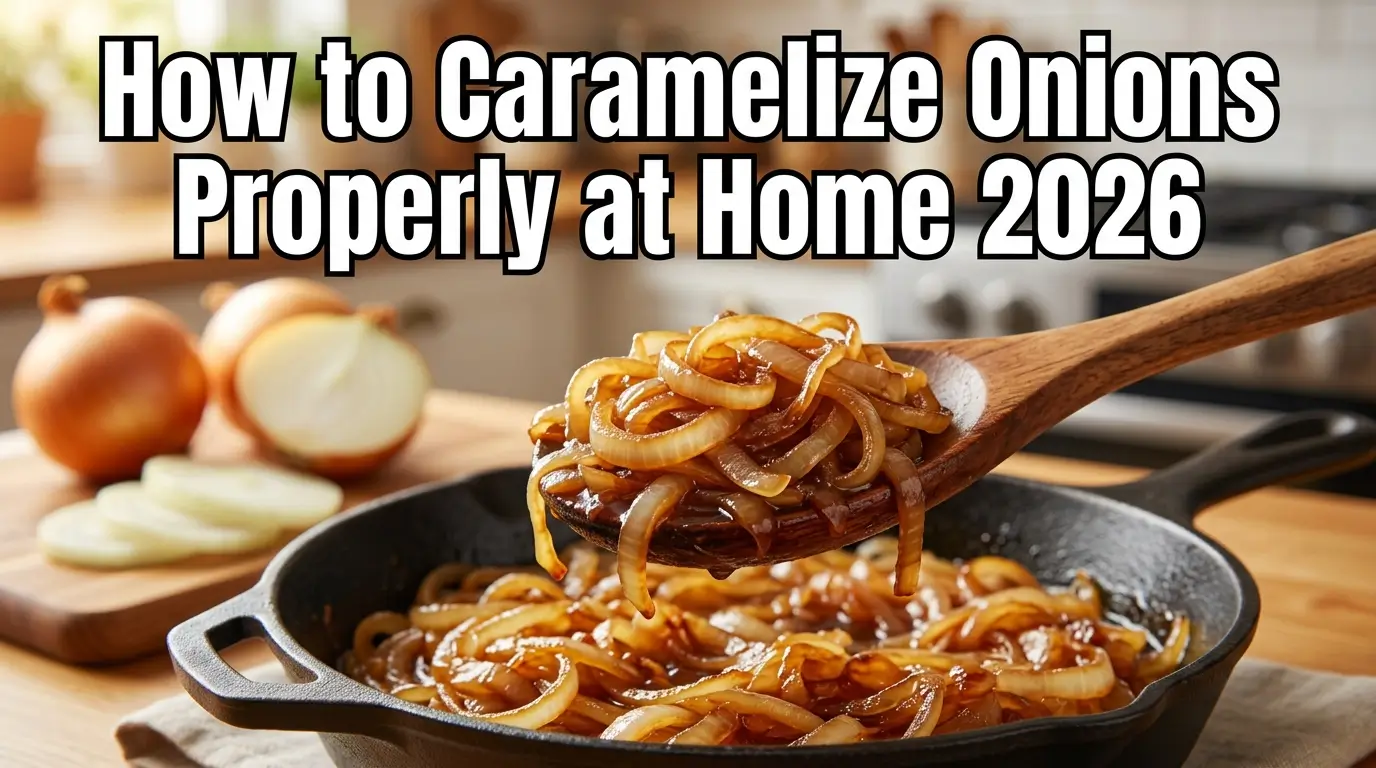
How to Caramelize Onions Properly at Home
All of the recipes that require caramelised onions are lies. Not a little. A lot.
Sauté onions for 5 minutes or until they are caramelized. I have come across it in the recipes of the big food magazines, in cards for meal kits and cooking apps. I also tried it and came up with an average tasting, pale, slightly soft onion and I wondered, what did I do wrong?
Nothing. I’ve got the wrong recipe!
Julia Moskin looked into this for the NYT and discovered that almost every recipe in every major publication was missing about 30–50 minutes from the caramelization time. In fact the minimum to get real caramelized onions is 45 minutes. Typically an hour or so. This is not a guideline, it’s chemistry.
When I came to a place of surrender and took my sword out of my hand, everything changed. So, let’s begin there.
Why Caramelizing Onions Takes So Long
Raw onions contain 89% water. That water needs to cook off before any caramelization can take place. Don’t just brown onions, you spent 20 minutes removing most of the water, and only after that did the natural sugars begin to concentrate, break down and transform.
There are two chemical reactions that give caramelized onions their flavor.
The first is simply the caramelization process: the pyrolysis of sugar molecules under heat. The sugars in the onion are broken down into hundreds of new flavor and colour compounds. This gives rise to the amber colour and the rich sweet flavour.
The second is the Maillard reaction, which is between amino acids and reducing sugars that create roasted complexity and browning. It is that which provides the umami richness to caramelized onions, and not the sweetness.
These can’t come about fast. The water must be removed from both and they must be maintained at the correct temperature for a long enough period. Turn the heat up to “rush” and the surface compounds will be burned before the interior of the food breaks down. You will have brown color and bitter taste — the kind of caramelized onion most “fast caramelized onion” recipes actually yield.
Raw onions contain a compound called inulin, which is a naturally tasteless chain sugar, too. When it is slowly cooked, it turns into fructose, the true sweetener, that acts in both browning reactions. One of the reasons, slow cooked onions taste so different from what you can make using a high heat method.
Which Onion to Use
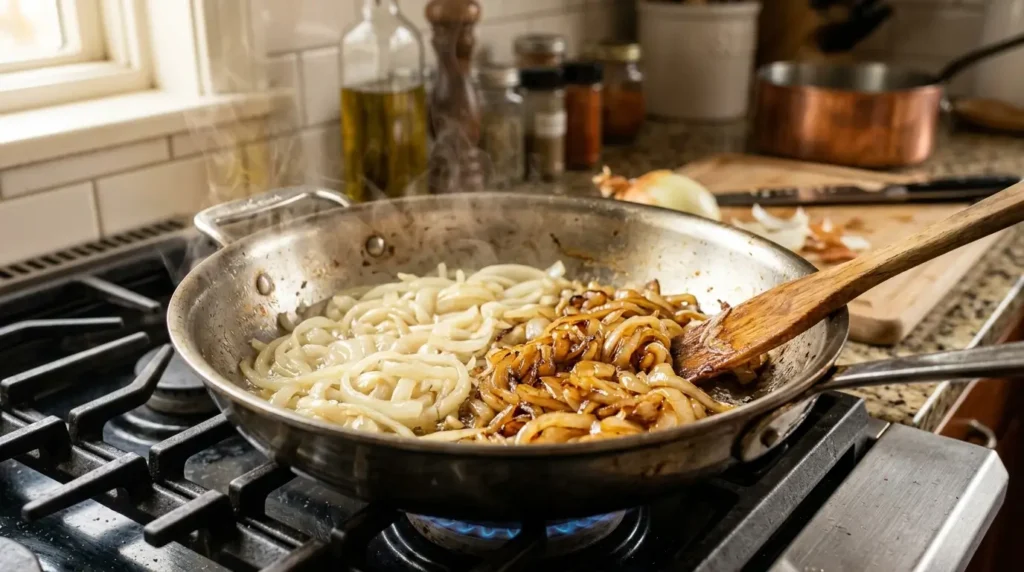
The short answer is: YELLOW ONIONS! Unless, of course, there is a good reason for deviating from this rule every time.
The highest to the lowest onion sugar level: on the extreme left, yellow and brown onions contain the most sugar (Sugar LevelResultYellow (brown)); at the center, all-purpose onions (Sugar LevelMedium); on the right, sweet onion varieties of Vidalia or Walla Walla have a very high sugar level (Sugar LevelVery high); in the middle, white onions have a medium sugar level (Sugar LevelMedium); in the middle right, shallots have a very high sugar level (Sugar LevelHigh); in the center-half, the mild refined sugar level is very high (Sugar LevelVery high), and the flavor profile is less deep and is similar to a wine.
Onions grown under a USDA protected geographic designation in Vidalia, Georgia caramelize slightly quicker due to the higher amount of fructose. If you’re looking for a sweeter, milder effect, they are great! However, any grocery store-caught plain yellow onion will provide better savoury balance.
Onion reds are effective, but they get a murky purple-brown hue which is unappetizing. I have done it when I didn’t have anything else. It’s a fine sauce, no visual.
Also Read: Simple One-Pot Meals for Beginners 2026
The Pan Matters More Than Most People Think
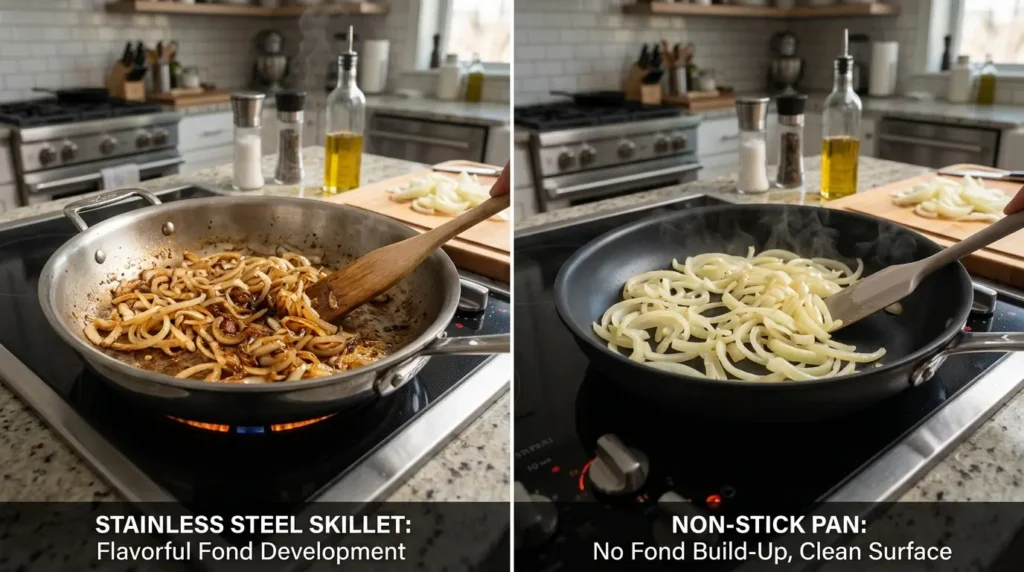
A non-stick pan is not a good option. They do everything they can to keep the fond from being built — fond is where a huge amount of the flavor is from.
In French cuisine the term fond refers to the caramelized sugars and proteins that adhere to the bottom of the pan during cooking. It seems that it should be scraped off. It doesn’t. It must be deglazed and added to the onions. It’s flavor, it’s not a mess.
The thin aluminum skillets tend to overcook, as they have hot spots and don’t cook the food evenly.
A less discussed aspect of the pan size is its ability to fit inside the oven. Onions are too small and they steam rather than brown and they take a lot longer. If it is too large, too much moisture will be lost, it will freeze out too quickly and the onions may scorch without softening sufficiently.
A 12-inch skillet is just right for 2 pounds of sliced onions (approx. 4 large onions). When preparing 3–4 pounds, use the widest Dutch oven or the largest skillet that you own.
The Classic Stovetop Method
This is the one. Any other method or alternative, such as an oven, slow cooker, instant pot, baking soda, etc., is a modification or short-cut, and will have tradeoffs. This is the benchmark that is used to compare all the others.
What you need:
- 2 lbs (900g) of onions, yellow (approx 4 large)
- 2 tablespoons unsalted butter
- 1 tablespoon of neutral oil (avocado, canola or sunflower)
- 1/2 teaspoon kosher salt
- Any water, dry white wine or dry sherry will do for deglazing liquid
Steps:
- Cut onions in half and peel. Cut into 1/4″ half moon pieces. When things are cooked evenly, thick parts will not be overdone while thin parts will not be underdone, thanks to the uniform thickness.
- Heat over medium heat in pan. In a bowl mix butter and oil together. The smoke point of the butter is increased by the oil, so that it does not burn during the extended cook time.
- Add the onions. Immediately add the salt. The first softening process will be accelerated due to the extraction of water by salt. Stir to coat.
- Lower to medium-low heat. This is a key change to make. Medium-low is a low, steady “sizzle.” Not silent. Not aggressive.
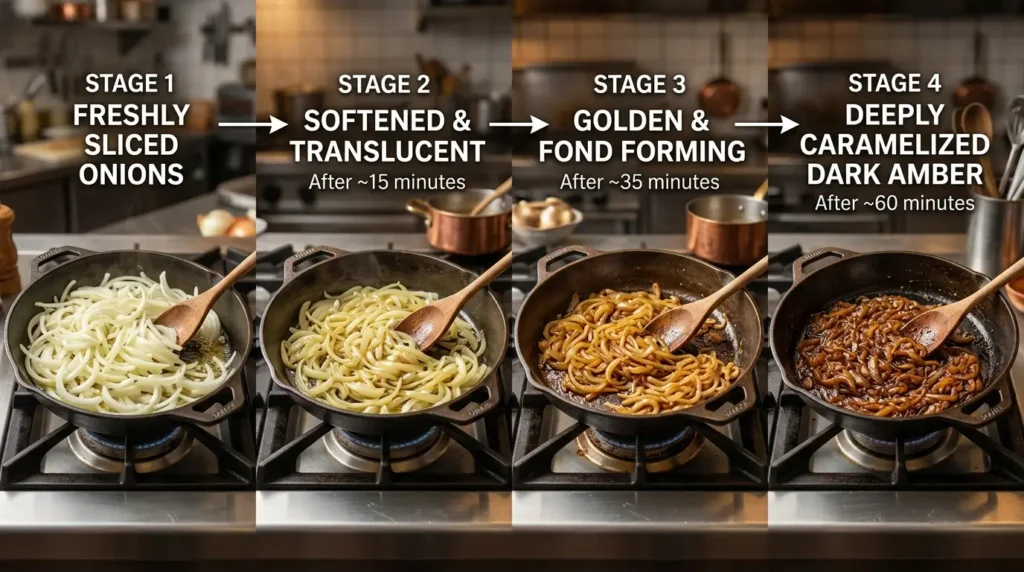
- Stir frequently, 5–8 minutes, until after 20 minutes. The onions will wilt, sweat and begin to fall. This is only a water out. Nothing exciting yet.
- About the 25–30 minute mark, the volume will have decreased considerably, and you will notice the beginning of the golden color. Fond building has begun on bottom of pan. Don’t scratch it off, deglaze it. Stir in 2 tablespoons of water (or wine) and mix up the brown bits with a wooden spoon. Add them to onions and mix.
- Cook for a further 15–25 minutes, stirring more often. Sugars will be condensed and will burn rapidly if left unattended. Repeat the deglazing process if necessary.
- Remove from heat when the bottom is deep amber with an intense sweet and savory taste.
The Stage-by-Stage Guide
After 30 minutes, gently lift the fond and remove from the pan.
In fact, smell is one of the best indicators of doneness. If the kitchen begins to smell of caramel that has a savory undertone, you’re still in target zone, but not raw onion or burnt sugar. This is the main indicator every know-how chef employs. It’s hardly ever mentioned in any recipe at all.
The Baking Soda Method: Science, Verdict, and When to Use It
America’s Test Kitchen later expanded upon this and J. Kenji López-Alt was instrumental in popularizing this concept on Serious Eats. The principle: a small amount of baking soda will increase the pH of the onions, which becomes more alkaline. The higher the pH the faster the Maillard reaction, and the faster the conversion of inulin to fructose. Both browning reactions occur more rapidly.
America’s Test Kitchen discovered that if they added water to the baking soda mix, it would make soft sweet onions in about 15–20 minutes, rather than 45–60.
The science is true. There is a flavor compromise to be made.
Onions cooked with baking soda are softer, sweeter and more evenly cooked than traditional onions at this stage. They are, however, shallower in depth than one would find in a full slow caramelized. Food52 baked it all right side by side and said that the baking soda version was “one-note sweet,” while the traditional version is “savory-sweet.” A few evaluators reported a slight chemical lingering taste at high levels (more than a pinch).
The verdict:
- Apply baking soda (1/4 tsp per pound of onions — max!) to: burger topping, dips, pizza topping and anything where you want the sweet soft onions fast and where the dish has lots of competing flavors.
- Apply this traditional way for: French onion soup, pissaladière, onion tarts, anything where the onion is the main character and depth is important.
If you use baking soda, don’t exceed the ratio. Approximately 1/4 teaspoon per pound is used in the ATK method. If there is any more, then you can begin to taste it.
Deglazing: Which Liquid for Which Dish
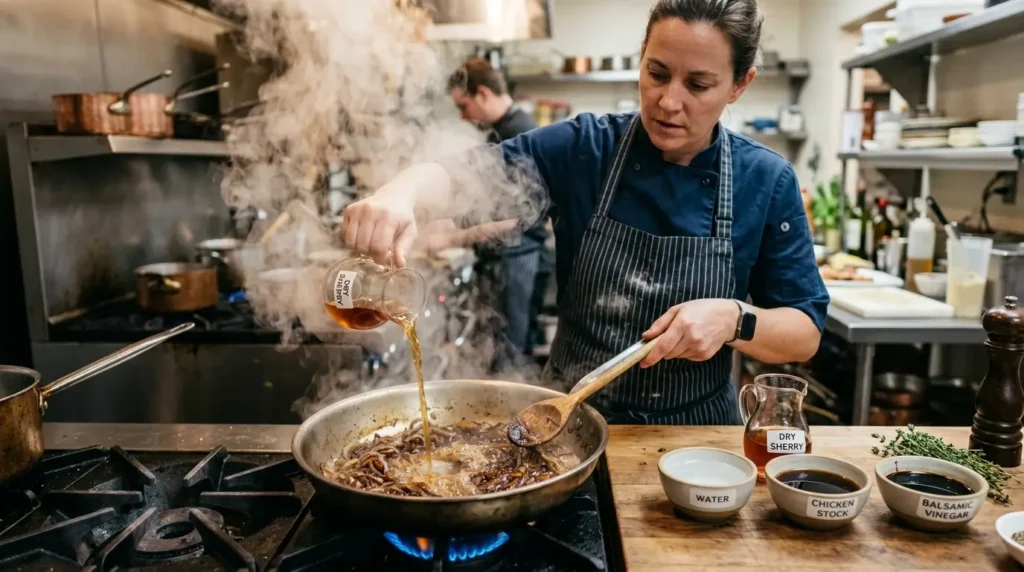
Each time you deglaze, you make a choice which will impact the final flavor. The principle of the technique is the same: a small amount of hot liquid impact on the fond, scraping and stirring but what is used does make the difference.
| Liquid | Best For |
|---|---|
| Water | Neutral; any dish |
| Dry white wine | Chicken, fish, vegetarian dishes |
| Dry sherry or Madeira | French onion soup, beef dishes |
| Balsamic vinegar | Flatbreads, bruschetta, cheese pairings |
| Chicken stock | Added body, savory depth |
| Beef stock | Rich stews, red meat dishes |
| Beer (lager or ale) | Burgers, pub-style applications |
Dry sherry or Madeira are the staple flavors for French onion soup, the way they have an accent of nutty, winey notes is part of what makes them so. Water is everywhere but doesn’t do anything.
Alternative Methods
Oven Method
Best for preparing a large quantity and leaving it unattended. Add butter and salt to a thick bottomed roasting pan or Dutch oven and toss sliced onions. Cover, roast at 375°F (190°C) for 45 minutes. Uncover, stir and continue stirring for 20–30 more minutes until deep amber.
The oven is more consistent and has less fond development. French onion soup or anything like that that requires a lot of depth is still my preference over stovetop. Oven is a more convenient option for meal prep and batches to freeze.
Slow Cooker
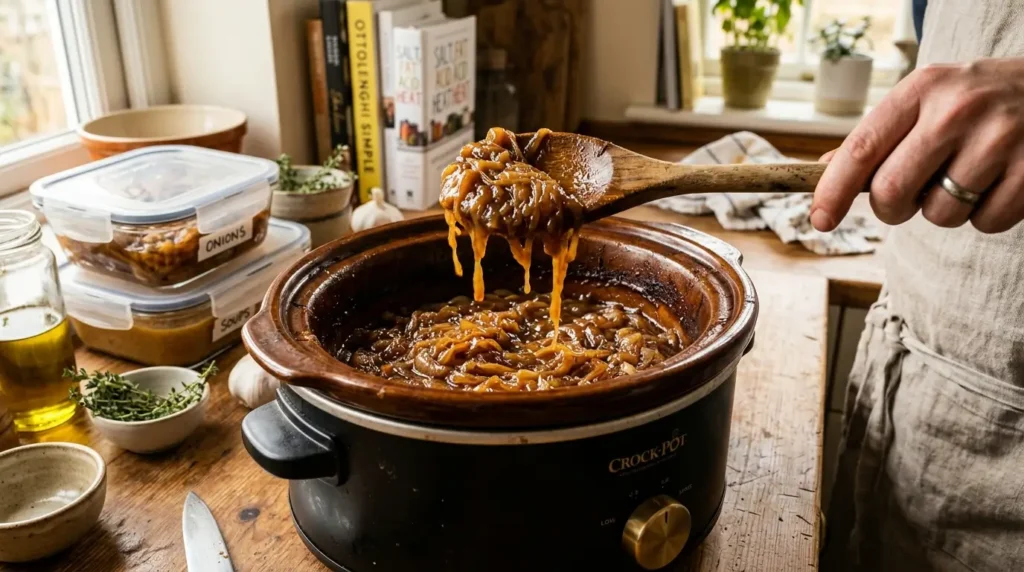
Add 4–6 sliced onions, 2 tablespoons butter and 1/2 teaspoon salt. Cook on HIGH, opening lid slightly wide for last 2 hours if needed to escape moisture, for 8–10 hours. The outcome is smooth and jam-like, ideal for dips, spreads and frozen batches. Poorly made development, not as on the stove.
Instant Pot
This approach has become popular in many home cookery groups, and is only briefly mentioned somewhere. It does work but with some restrictions.
Sauté Onion (High) for 10 minutes in butter and salt, stirring regularly. Then add a splash of water (2–3 tablespoons), seal and pressure cook on HIGH for 20 minutes. Quick release. Return to sauté and until the onions are reduced to a desired consistency, cook off any excess moisture.
The end product is super soft and sweet, rather than the stovetop version. Great for sauces, soups and dips. Does not have the variation in texture and depth of stovetop. But when you need a big batch of it in 45 minutes in total, it works.
When Things Go Wrong
They’re burning before turning sweet
Heat is too high. Use a spatula to rub down the pan, using less heat and 2 tablespoons of water. You can save the life of the fond if it is dark brown and not black. If it is black and pungent, it is contaminated; try again.
They are soft and watery, but do not brown
The quantity is too much for the pan: steaming instead of dry-heat caramelization. Move to a bigger pot or do in two portions. You can also take off the lid (if it’s used) to speed up moisture loss.
They taste bitter
Possible causes: the heat was too high (burnt surface compounds), too much baking soda added or the fond charred and not caramelized. It is not possible to correct bitter fond, it will permeate the onions and is all the way through.
After just 20 minutes, they’re not much smaller
This is normal. Onions with 89% water content require time to diminish. After 30 minutes, you should have 40–50% reduction in volume. Don’t be afraid of the 25-minute mark!
They have a strong, piercing or sharp smell even after 30 minutes
Alliums contain sulfur compounds which need time to transform to sweet molecules. If the odor of the raw onion still persists after 30 minutes, the heat is probably too low. Nudge it up just a little bit — you want good and active sizzle all over.
Storage and Reheating
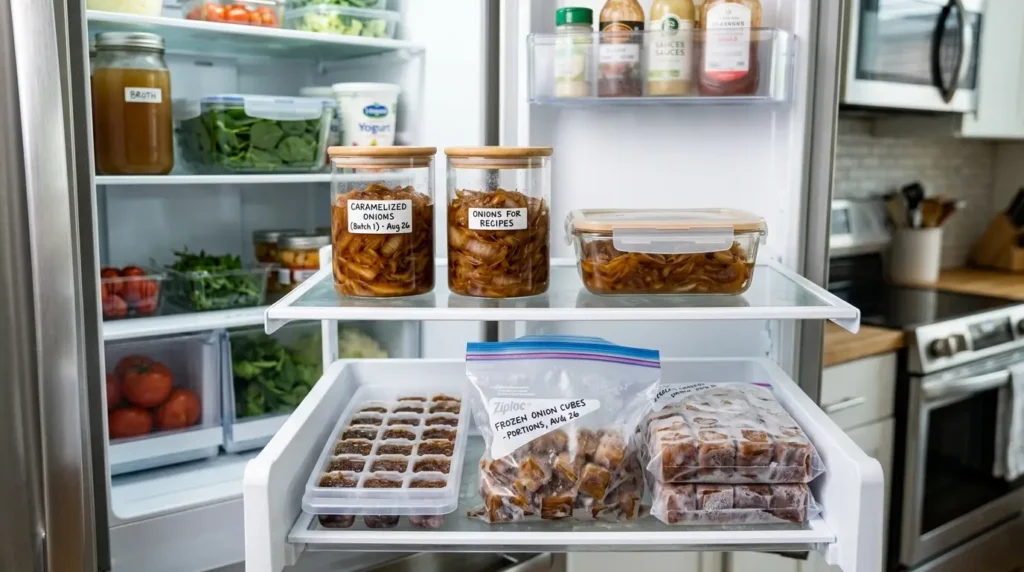
Caramelized onions can be stored in an airtight container in the refrigerator for 5–7 days. They tend to be fresher the second day, when the tastes have calmed down.
For freezing: divide into ice cube tray and freeze until solid, then place in a zip-lock bag. Stores for up to 3 months. A single serving of each cube is about 1–2 tablespoons, which is a good amount to make a burger top or pasta.
To reheat without compromising the texture, heat on a skillet (small) at low heat with a tablespoon of water or butter. Then it takes 2–3 minutes and they will be back. The microwave can be used in an emergency but the end product is a little sticky. It takes 3 minutes to cook in the pan and it retains their flavor.
What to Actually Do With Them
The classics: French onion soup, burger toppings, grilled cheese, pizza bases, onion tart, flatbreads with ricotta, pasta with goat cheese.
The not so obvious ones: Fold into scrambled eggs, spread on crostini with blue cheese, add to mashed potatoes, put on roasted root vegetables, make an onion dip that is even better than the packet ones, etc.
This is what onion is able to do at the high end in France: Onion confit, for example, is cooked and preserved in fat; or the Provençal flatbread, which is topped with anchovy, olive and caramelized onion from Nice, called pissaladière. In Persian cuisine, the onions are the equivalent to piaz da tamam, the onions that are very browned and used in the preparation of many rice dishes. Soffritto and mirepoix are both Italian cooking techniques that use a similar method as the flavor base.
The ingredient is quite universal. The 45-minute investment yields something that takes almost anything good and enhances it.
FAQs
How long does it really take to caramelize onions?
Medium to low heat for 45–60 minutes. Any recipes indicating a time between 10 and 15 minutes are either not caramelizing but rather softening the color (which is not the same), or they’re going for a high heat that would burn the sugar without caramelizing. This is confirmed by NYT investigation by Julia Moskin (almost all big recipe publications underestimate the time).
What is the baking soda trick for caramelized onions?
The addition of 1/4 teaspoon baking soda per pound of onions increases the pH, thus speeding up the Maillard reaction and increasing the conversion of inulin to fructose. J. Kenji López-Alt is responsible for creating this method. It yields sweet and soft onions in around 15–20 minutes. The compromise: the flavor is less interesting than the slow caramelization, and quantities greater than 1/4 tsp per pound of roast may give a slight chemical aftertaste.
What pan is best for caramelizing onions?
A thick sided cast iron or stainless steel skillet. Both will develop fond and are easy to deglaze. A non-stick pan will not allow sides to form, taking away another source of flavor. Thin pans will result in “hot spots” which will lead to uneven browning.
Can you caramelize onions in advance?
Yes, they’re usually better the day after. Refrigerate in a closed container for up to 7 days or freeze in small amounts for up to 3 months. Reheat over low heat in a skillet with a little water or butter, 2–3 minutes.
Why do my caramelized onions taste bitter?
Most likely causes: heat was too high, excessive baking soda, fond not caramelized, but charred instead. Just a little of dark fond will do the trick and add depth. Fully charred fond is bitter and not possible to cook out after adding to onions.
Should you put a lid on when caramelizing onions?
Not usually. A lid catches steam that may hasten the first softening step, but retard browning. A few cooks will employ the use of a lid for the first 10–15 minutes in order to speed up the moisture out, then remove it to help the caramelization process. When using the slow stovetop method, it is normal for cooking to be uncovered throughout.
Can you caramelize diced onions instead of sliced?
Yes, but sliced (half-moons) caramelize more evenly and produce a better texture for most applications. Caramelized diced onions are quicker to caramelize, hold together better and are ideal when using smaller chunks, such as the base for a sauce or dip. Sliced onions give the classic jammy strands to be used in tarts, soups, and as toppings.
Can you caramelize shallots the same way?
Yes. Smaller size and higher sugar density make shallots caramelize a little quicker than yellow onions. Repeat with the same method and heat, but at 35–40 minutes instead of 1 hour. It is more winey and mellow and is perfect for French cuisine and any creamy sauces.
Leave a Reply