Basic Cooking Skills for New Home Cooks
Knife Skills:
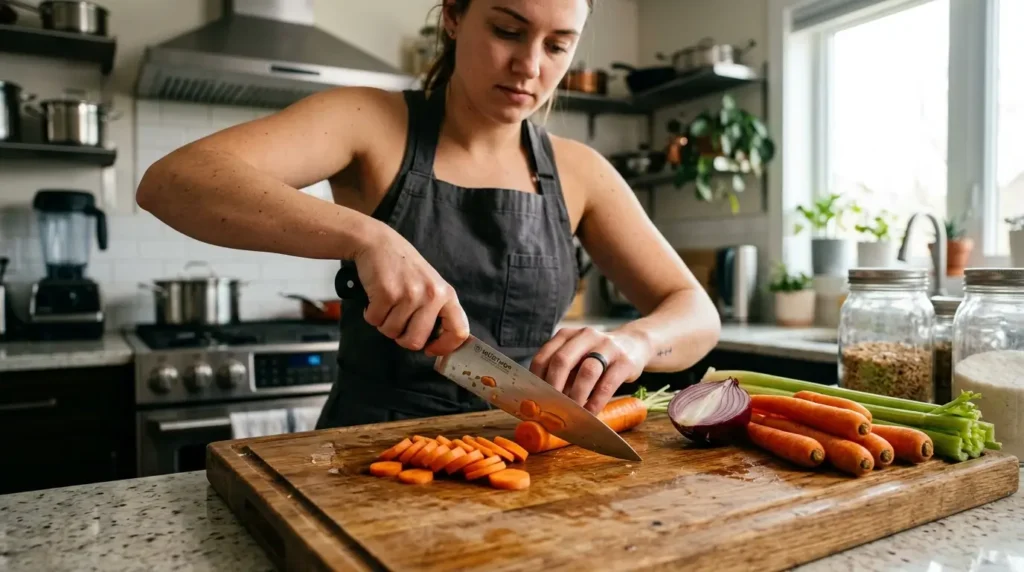
Knife skills are the foundation of cooking. A proper pinch grip and claw technique prevent injuries and ensure uniform cuts, which leads to even cooking.
The knife is the most dangerous tool in your kitchen, but only if you hold it wrong. Most beginners grab the handle like a hammer. This makes the blade wobble. You lose control.
Hold the knife using the pinch grip. Pinch the base of the blade right above the handle with your thumb and index finger. Wrap your remaining fingers around the handle. The blade becomes an extension of your arm.
Your other hand needs protection. Form a claw. Curl your fingertips inward like a bear. Let the flat side of the blade rest against your knuckles. Your knuckles guide the knife. Your fingertips stay out of the blade’s path.
Uniform cuts matter. If you chop carrots into random sizes, the small pieces burn while the large pieces stay hard.
| Cut Name | Size | Best Use |
|---|---|---|
| Dice | 1/2 inch | Soups, stews |
| Mince | Very fine | Garlic, herbs |
| Julienne | Matchsticks | Stir fries, salads |
When you dice an onion, cut it in half root to tip. Peel it. Make vertical cuts toward the root, but do not cut through the root. The root holds the onion together. Make horizontal cuts. Slice down. You get perfect dice without the onion falling apart.
Heat Control:
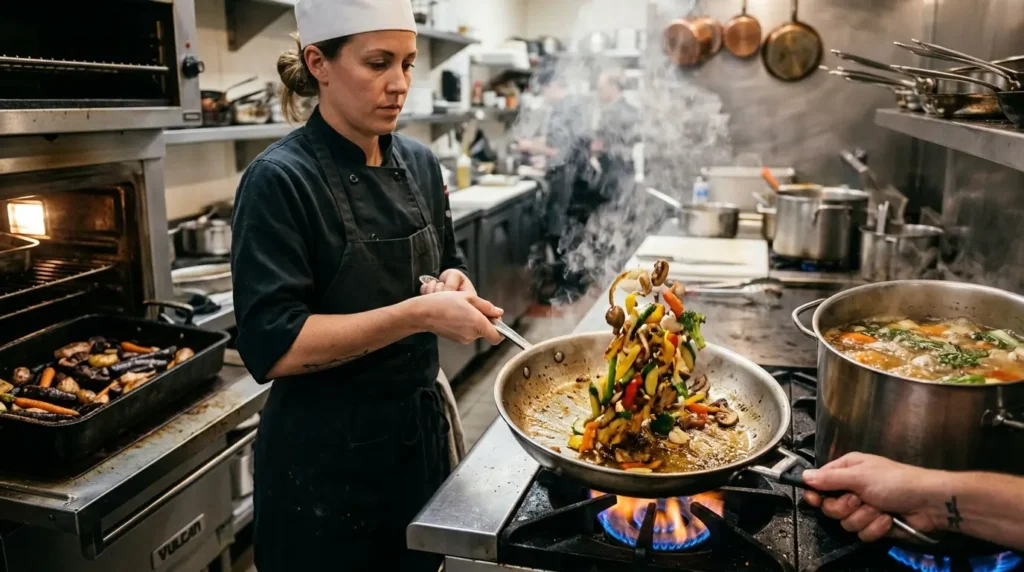
Heat control determines how food cooks. Dry heat methods like sauteing create browning through the Maillard reaction, while moist heat methods like simmering tenderize food.
Heat transforms ingredients. You control the transformation by choosing dry heat or moist heat.
Dry heat uses hot air, metal, or fat. Think roasting, baking, and sauteing. These methods trigger the Maillard reaction. The Maillard reaction is a chemical process where amino acids and sugars brown under heat. It creates complex flavors. That brown crust on a steak is Maillard. The crispy edges on roasted carrots are Maillard.
Moist heat uses water or steam. Think boiling, simmering, and steaming. These methods soften tough fibers. They do not brown food.
Sauteing is the most common dry heat method for weeknight dinners. Saute means to jump. You cook food fast in a small amount of fat over medium-high heat. Put oil in a hot pan. Wait until the oil shimmers. Add your vegetables or thin proteins. Listen to the pan. A constant sizzle means the water is evaporating and the food is browning. Silence means the pan is too cold. Smoking means the pan is too hot.
Boiling and simmering are the two moist heat methods beginners confuse.
| Method | Temperature | Bubble Activity | Best Use |
|---|---|---|---|
| Boiling | 212F / 100C | Large, violent | Pasta, blanching |
| Simmering | 185F / 85C | Small, gentle | Soups, stews, braises |
Boil pasta. Simmer chili. If you boil chili, the aggressive bubbles smash the beans into paste and toughen the meat.
A common beginner mistake is overcrowding the pan. You toss a pound of chicken into a small skillet. The chicken drops the pan temperature. The chicken releases water. Instead of sauteing, the chicken boils in its own juices. You get gray, rubbery meat. Cook in batches. Give the food space so the moisture evaporates.
Flavor Building:
Flavor building relies on balancing salt, acid, fat, and heat. Proper seasoning enhances natural ingredients and adds depth through umami.
Most beginners under-season food. They sprinkle salt on top of a cooked meal like snow. The outside tastes salty. The inside tastes flat.
Season during the cooking process. If you boil pasta, the water should taste like the sea. The pasta absorbs the salt as it cooks. If you roast vegetables, salt them before they hit the oven. Salt draws out moisture, which aids browning.
Use kosher salt. Table salt pours fast and ruins dishes. Kosher salt has large flakes. You can pinch it and feel how much you add. It costs about $3 for a box that lasts six months.
Salt is not the only seasoning. Acid is the secret weapon. Lemon juice, lime juice, and vinegar cut through richness and brighten dull flavors. If a pot of soup tastes boring, do not add more salt. Squeeze half a lemon into it. Taste the difference.
Umami is the fifth taste. It translates to pleasant savory taste. Build umami using soy sauce, tomatoes, mushrooms, parmesan cheese, and fish sauce. A dash of soy sauce in a beef stew adds meaty depth without making it taste Asian.
Mirepoix is a flavor base used in French cooking. It consists of two parts onion, one part carrot, and one part celery. You sweat these vegetables in fat over low heat. They release sweetness. Mirepoix forms the foundation of soups, stews, and sauces worldwide.
Also Read: Easy Dinner Recipes for Beginners at Home 2026
Essential Kitchen Equipment:
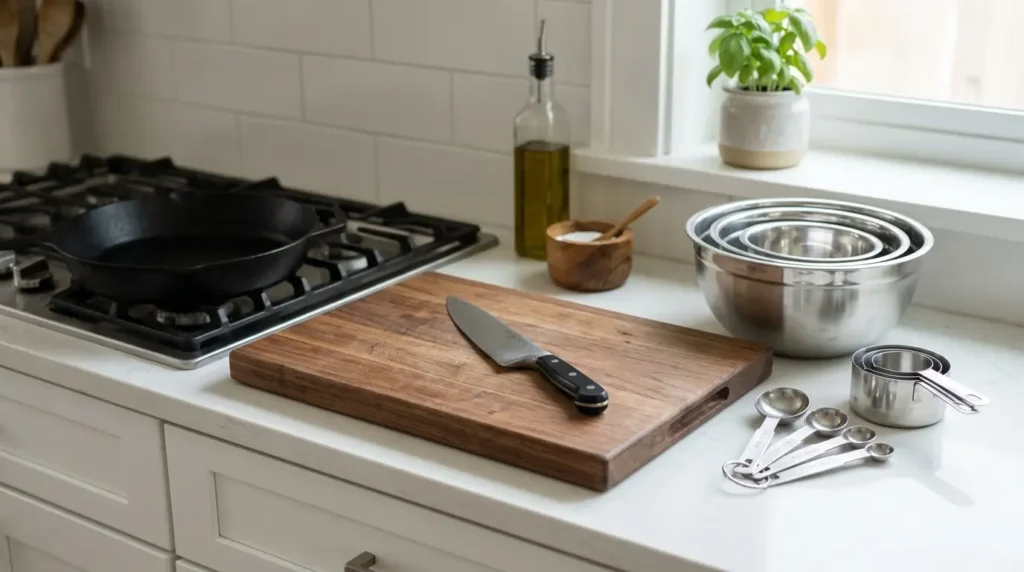
Essential kitchen equipment includes a chef’s knife, a cutting board, and a heavy-bottomed pan. These core tools handle most cooking tasks.
You do not need a kitchen with $5000 worth of gadgets. You need three core tools.
Buy an 8-inch chef’s knife. A Victorinox Fibrox costs about $35 USD, 30 EUR, or 25 GBP. It holds an edge and feels balanced. Skip the knife block sets. You will use one knife 90 percent of the time.
Buy a large cutting board. Small boards are dangerous. Food falls off the edges. Get a heavy plastic or wood board at least 18 by 12 inches. Place a damp paper towel under the board so it does not slide.
Buy a heavy-bottomed stainless steel or cast iron skillet. Thin pans warp and create hot spots. Food burns in the center and stays raw at the edges. A 10-inch Lodge cast iron skillet costs around $25 USD. It holds heat, sears meat, and moves from the stovetop or hob directly into the oven.
Starter kitchen tool kits cost between $50 and $150 USD depending on brand and material quality. Stick to the basics. Avoid single-use tools like avocado slicers or banana cutters.
Food Safety:
Food safety prevents illness and injury. Use separate cutting boards for raw meat, cook poultry to 165F / 74C, and never put water on a grease fire.
The kitchen has real hazards. Respect them.
Cross-contamination causes food poisoning. Raw chicken carries salmonella. Use one cutting board for raw meat. Use a different board for fresh vegetables. Wash your hands with soap for 20 seconds after touching raw meat. Sanitize the counter.
Temperature matters. Poultry must reach an internal temperature of 165F or 74C. Ground meat needs 160F or 71C. Buy a digital instant-read thermometer. They cost $15. They eliminate the guesswork. You will never serve raw chicken again.
Grease fires happen when oil gets too hot. Water makes grease fires explode. The water vaporizes instantly and throws burning oil everywhere. If a pan catches fire, turn off the heat. Cover the pan with a metal lid to smother the flames. Pour baking soda on small grease fires. Keep a fire extinguisher rated for kitchen fires nearby.
Troubleshooting Common Mistakes:
Mistakes happen. I ruined many meals. You will too. The key is knowing how to rescue the situation.
If you burn garlic, throw it away. Burnt garlic tastes bitter and acrid. It ruins the whole dish. Start over.
If you over-salt a soup, add a peeled raw potato. Simmer for 15 minutes. The potato absorbs some salt. Remove the potato before serving. You can also add more liquid or a splash of acid to balance the salt.
If food sticks to the pan, stop pulling it. Protein releases from the pan when the Maillard reaction finishes. Wait 30 seconds. Try to lift an edge. If it resists, leave it alone. When it forms a crust, it releases on its own.
If your sauce breaks and looks greasy, whisk in a tablespoon of cold water or an ice cube. The temperature shock brings the emulsion back together.
Cooking relies on sensory cues. Recipes give times, but ovens vary. Your eyes, ears, and nose tell the truth. Look for color. Listen for the sizzle. Smell for toast. When garlic turns golden, it is done. When it turns brown, it is burnt. Trust your senses over the timer.
FAQs
What are the 5 basic cooking skills?
Knife skills, sauteing, roasting, boiling, and seasoning. These five techniques let you prepare thousands of different meals from scratch.
How do I teach myself to cook?
Focus on one technique at a time. Master scrambled eggs. Then learn to roast vegetables. Skip complex recipes. Cook simple dishes until the motions feel natural.
What should a beginner cook first?
Roast vegetables. Chop carrots, broccoli, or potatoes. Toss them in olive oil, salt, and pepper. Roast at 400F or 200C until they have brown edges. This teaches heat control and timing without risk.
Why does my food always taste bland?
You lack salt or acid. Salt your food while it cooks, not after. Add a squeeze of lemon juice or a splash of vinegar at the end to wake up the flavors.
What is the hardest cooking skill to learn?
Temperature control. Knowing when a pan is hot enough to sear meat, or when a simmer is gentle enough for a braise, requires practice and attention to sensory cues.
Is cooking at home cheaper than eating out?
Yes. A restaurant meal costs you for the ingredients, the labor, the rent, and the service. The same meal cooked at home costs a fraction of the price.
Why does my food stick to the pan?
You added food to a cold pan, or you tried to flip the food before it formed a crust. Preheat the pan, add oil, wait for the shimmer, and let the food release on its own.
Conclusion
You do not need culinary school to feed yourself. You need a sharp knife, a hot pan, and an understanding of how salt and heat work. Start small. Chop an onion. Sauté it in oil. Watch the color change. Taste the sweetness. The kitchen is a place of trial and error. You will burn things. You will under-season things. It is part of the process. The more you stand at the stove, the more control you gain over the outcome.
Leave a Reply